Poultrymad© Call Duck
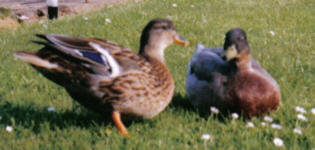
The origin of the bantam duck known as the 'Call' is not clear. Early experts
such as Lewis Wright and Harrison Weir describe their use as decoys on shooting
ponds. Even earlier in a book by Francis Willoughby in 1755 he describes the
breed as Coy duck, which may refer to decoy or possibly 'kooi' which means cage
in the Dutch language.
The Dutch Call Duck as they became known, were much smaller than the normal
English decoy-duck and had been developed using imports of duck into Holland
from the then Dutch East Indies, now Indonesia.
Dutch 'experts' such as Cornelis Van Gink in 1932 and more recently, Hans
Schippers in 1997 have described these birds as having originated in the far
east such as Indonesia and even Japan and imported to the Netherlands where they
were further developed.
It has been suggested that the Laysan Teal were used in the development of
the Dutch Call Duck. The Laysan Teal have characteristics that are evident in
Call Duck, such as the short and compact body, orange coloured legs, short beak,
shrill quacking. In Holland the Call is actually known as the 'Kwaker' because
of its shrill piping call (especially the female).
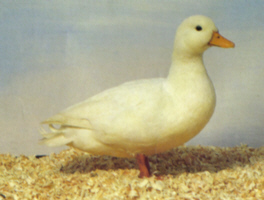
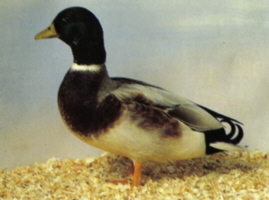
Earlier only White and Grey (Mallard) colours were available but as the breed
has developed further a wide range of colours are available including, White,
Grey, Fawn, Blue Fawn, Apricot, Silver, Pied, Black, Lavender, amongst other
variations. |