Poultrymad© Wyandotte
For a breed of so recent origin, the history and formulation of the Wyandotte
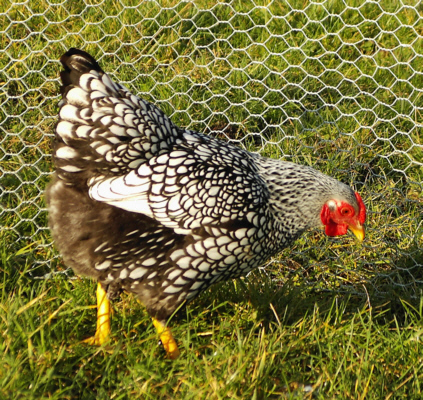
is not clear-cut. The Silver Wyandottes were the first to be produced by using
the following crossings; a Sebright cock crossed with the progeny of a Silver
Spangled Hamburgh cock and a Cochin hen. Further breeding from these resulted in
a sample bird being put before the American Standards Committee in 1876 as an
American Sebright, but the committee rejected it, partly on the grounds of its
head and comb shape.
More cross-breeding included both Light and Dark Brahma females with a Silver
Pencilled Hamburgh male being introduced and it appears that Silver Laced
Polands were also involved; they seem to be the obvious choice to install some
lacing. Lewis Wright (in his famous book of poultry) also reports that some of
the early imports to Britain showed signs of a crest which endorsed the Polands
theory.
Sir Edward Brown recalls seeing some of the birds during their development
and they included feathered legs and clean legs, rose, single and pea types of
combs. These birds continued to be bred together until 1883, when they were
standardised as Wyandottes, named after a tribe of North American aboriginals.
The shape for the Wyandotte should be the same for all the colours. The
Wyandotte has been described as the bird of curves, and that is what it is, with
each of the curves being clearly defined. This is possibly due to the feather
structure being strong enough to hold the shape, whilst at the same time having
enough under feather to highlight the curves.
As with the body shape all the colours should have a broad rosecomb not so
wide that it hangs over the eyes but should fit closely to the head and should
be bright red. Dark orange or red coloured eyes are the preferred standard.
Colours are as follows:-
White, Blue, Buff, Red, Black, Barred, Partridge and Silver
Pencilled, Silver, Gold, Blue and Buff Laced, and finally Columbian (similar
markings to Light Sussex). |